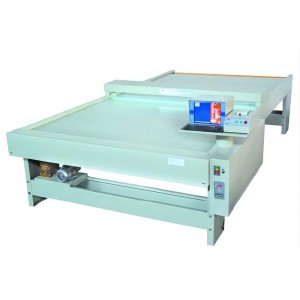
Leather Stacking Machine
Features
Industrial-grade control system: Utilizing dedicated industrial control computers, with in-house development of both hardware and software, the system boasts high compatibility and strong anti-interference capabilities, adapting well to the harsh environment of tanning workshops, and featuring long-lasting core components.
Multi-machine interlocking: It can seamlessly integrate with leather equipment such as spraying machines, embossing machines, ironing machines, buffing machines, leather measuring machines, polishing machines, softening machines, and roller coating machines, enabling immediate palletizing upon material discharge. (AS FOLLOWING:)


Continuous automatic stacking: The hides are laid down one by one continuously, eliminating the need for manual palletizing in the production line, thereby significantly enhancing the overall production efficiency.
Adjustable stacking patterns: Parameters such as half-sheet/full-sheet stacking, number of sheets per stack, and stacking bench travel can be set according to process requirements, adapting to different leather specifications.
Reduced labor dependency: Completely replacing manual skin pulling and laying operations, reducing labor intensity, decreasing dependence on skilled operators, and optimizing production line staffing.
Parameters
Working width (mm) conventional: 3400, 3300, 3200, 3000
(Other sizes available on request)
Adjustable height at leather end (mm):500-1600
Leather stacking height: up to 1800mm
Leather stacking lifting: manual + automatic
Control method: CNC servo + microcomputer + frequency conversion
Front and rear movement of the whole machine: on wheels
The way of stacking: horse mound, tile a whole sheet, tile a half sheet
Stacking function: obverse and forward, obverse and backward, obverse
and backward, etc., illustrated as follows:
Computer: Standard industrial computer
Size: Height: 2300-2500mm
Width: working width + 700mm
Length: short arm 5500mm, long arm: 6200mm
Weight: 2.2-3.5T


Applications
Finishing & spraying line end: It receives the output from the spraying machine and roller coating machine, and automatically stacks the finished leather sheets.
Ironing & embossing lines: It is integrated with the continuous ironing and embossing machine to ensure neat stacking of the embossed leather sheets.
After measuring and grading: Cooperate with the leather measuring machine to complete the counting and stacking of finished leather, facilitating subsequent packaging and storage.
Buffing & staking: Connecting the output of the buffing machine and the oscillating softening machine, achieving automatic transfer and stacking of leather sheets between processes.
FAQ
Q1: Can the stacker be integrated with my existing spraying machine/embossing machine?
A: Yes, the leather stacker is originally designed as a supporting equipment for various leather main machines. The equipment provides standard signal interfaces, which can be linked with the discharge signals of spraying machines, embossing machines, ironing machines, buffing machines, leather measuring machines, etc., to achieve automatic stacking as soon as the main machine discharges leather. The specific docking scheme needs to be confirmed based on the model of the main machine, discharge speed, and leather specifications.
Q2: For thin, soft leather or leather prone to curling, are they stacked neatly?
A: The equipment from us utilizes the relative motion between the conveyor platform and the stacking bench to facilitate the gradual laying of leather sheets under the influence of their own gravity and the conveyor belt. Coupled with adjustable stacking height control, it can accommodate the neat stacking of most conventional leather. For extremely thin or specially finished leather, it is recommended to provide samples for on-site machine testing and verification. If necessary, auxiliary flattening or adsorption devices can be installed.
Q3: Is the equipment reliable in the harsh environment of the tannery workshop?
A: This is precisely the core design consideration for the popular equipment. It adopts an industrial-grade dedicated control computer instead of a regular commercial PC, with both hardware and software developed in-house. The system is closed and has undergone targeted optimization, exhibiting significantly superior resistance to moisture, dust, and electromagnetic interference compared to general solutions. The selection of core electrical components is also configured according to industrial environmental standards, making it suitable for long-term continuous operation in tanning workshops.
Q4: Can the stacking height and the number of sheets per stack be adjusted according to production needs?
A: Yes, it can. Parameters such as stacking height, number of hides per stack, and the travel distance of the stacking bench can be set in the control system. Some models also support the switching between stacking half-hides and whole hides. Operators can flexibly adjust these parameters according to the requirements of subsequent processes (such as transportation, packaging, and storage).
Q5: How is equipment maintenance and after-sales support ensured?
A: The manufacturer has multiple offices and after-sales service centers in China, and has long-term stations in overseas markets such as Southeast Asia, enabling rapid response. Since the core software and hardware are independently developed, the continuity of spare parts supply and technical support is guaranteed, avoiding compatibility issues and uncontrollable risks in maintenance cycles brought by outsourcing general control systems.